
BlogForest Conservation
Crested Drongo Research on Nosy Komba
At the Madagascar Research and Conservation Institute, we didn’t just focus on reptiles and amphibians! Another big part of our research was looking at the abundance of bird species on Nosy Komba! At the time that I left MRCI, we had nearly 20 different sites across Nosy Komba that we used to conduct bird surveys. On our bird walks we’d conduct point count surveys, which involved silently watching and recording all sightings of birds within a certain distance from the survey site. We would also utilise the identification of bird calls to contribute to our data. These would prove particularly difficult for many of the volunteers that came through MRCI.
At the best of times bird calls aren’t the simplest things to identify, but the bird species on Nosy Komba didn’t make it any easier for us. Some of the most common bird species on the island just happened to have remarkably similar calls. For example, volunteers (and even some of the staff!) had great difficulty working out the difference between the calls of species like the Souimanga Sunbird (Cinnyris sovimanga) and the Madagascar Bulbul (Hypsipetes madagascariensis). These two species had a range of different calls that volunteers would need to learn, some of which you could only differentiate between because one was slightly higher pitched! It could take people months to be able to reliably tell the difference between them!
The Clever Mimic: Madagascar’s Crested Drongo
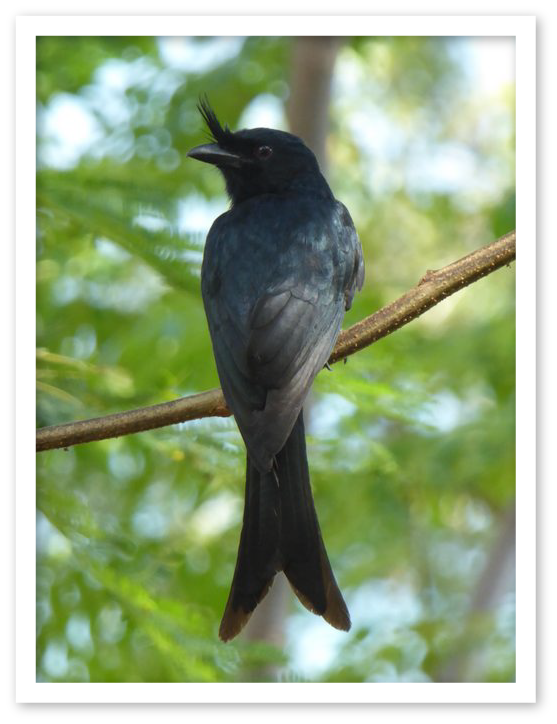
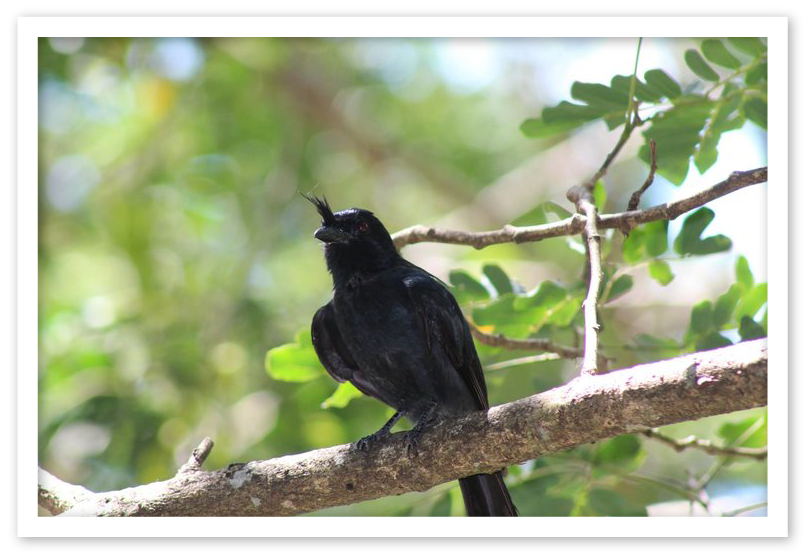
The Madagascar Crested Drongo (Dicrurus forficatus) is an amazing species with the ability to copy the calls of other birds, and even some mammals. This allows it to do some pretty cool stuff! The drongo is a relatively small bird, with gorgeous black glossy feathers. In a certain light those feathers can even gain a blue sheen, just to further confuse the bird surveyors! The keys that give these guys away though, are the plume of feathers above the bird’s beak and a longish tail with a widening fork. The crested drongo is common throughout Madagascar, and as a result has been judged as ‘Least Concern’ by the IUCN Red List. However, it is not found in the treeless plains and savannahs of the central plateau of the island, which indicates that it is a forest specialist. This is not overly surprising, as the drongo is a passerine, an order (Passeriforme) distinguished by their toe arrangement. They have three toes facing forwards, and one backwards, giving them an ideal set up for perching in trees. The Madagascar Crested Drongo has a great variety of calls, hardly a surprise when they are capable of mimicking birds AND mammals! I heard this myself one day while I was checking some of our butterfly traps that had been set up above camp. I was recording and releasing some of the butterflies that we had captured, when suddenly I heard a cat meowing. I was shocked, as I’d been checking these traps everyday for nearly the last two months and had never seen the camp cats anywhere around the survey area. As I tried to spot the cat, I became more and more confused as it was simply nowhere to be seen. Eventually I spotted a drongo in the shadow of a rock. As I watched, I saw it call out. Instead of hearing a bird call, I heard a meow… What the hell? This was the first time I’d seen first hand just how well the drongo was able to imitate other animals, and I hadn’t realised that their mimicry extended to mammals as well! To say I was surprised was an understatement!
Opportunistic Feeding and Smart Hunting
The purpose of the drongo’s mimicry is, for lack of a better word, brilliant. It will perch on a branch in the forest, waiting, and watching. At the opportune moment, it will loudly mimic (for example) the shriek of the Madagascar Buzzard (Buteo brachypterus) or the alarm call of another bird. This scares other birds into a frenzy, doing whatever they can to escape the area and avoid becoming the ‘buzzards’ next lunch! In the chaos a whole array of insects will be disturbed from their hiding places, with a number of them taking flight. It is at this point that the drongo swoops down from its perch, and feasts upon its now easily accessible prey. It also engages in some other pretty sneaky behaviour when it comes to finding food. The perches that the drongos prefer tend to be in the mid-canopy of the forest, particularly though in a very specific situation. The drongo notices when a bird, normally a larger species, sits towards the top of the trees and when a smaller species hunts lower to the ground. The drongo will stand watch, waiting for the opportune moment. As an insect tries to escape the hunting birds that sit around the drongo, it might move to the other side of a tree trunk. When it does so, as the other bird can no longer reach the bug, the drongo plucks it off the trunk and enjoys a comparatively easy easy meal!
If you look at these behaviours, it seems that the crested drongo can be a pretty mischievous little bird! But just how cheeky is it? Though no studies have been conducted of the Madagascar crested drongo specifically, they have been done on other species of drongo on mainland Africa. During this study, they recorded the Fork-Tailed Drongo (Dicrurus adsimilis) as having 51 different alarm calls. It has been shown that the drongo could obtain nearly a quarter of their daily food intake through stealing the prey of another species, which is a crazily high amount all things considered!
These are just two incredible behavioural adaptations that the Madagascar crested drongo has developed! The success of this kind of opportunistic hunting has helped the drongo to become one of the most common birds around Madagascar. Another thing that has helped to make the drongo so successful though is their natural aggression. The drongos are surprisingly aggressive little birds, that have been known to scare off larger birds. Staff members at MRCI told me about times that they witnessed a drongo attack and frighten off a buzzard, the largest bird of prey on Nosy Komba! That’s no mean feat for such a small bird!
The Crested Drongo in Malagasy Folklore
The drongo is a bit of a special bird in Malagasy culture too, and could even be described as a bit of a known quantity! In folklore, the drongo is known as the ‘king of the birds,’ but the story of how it gained this title will not sound overly surprising to you!
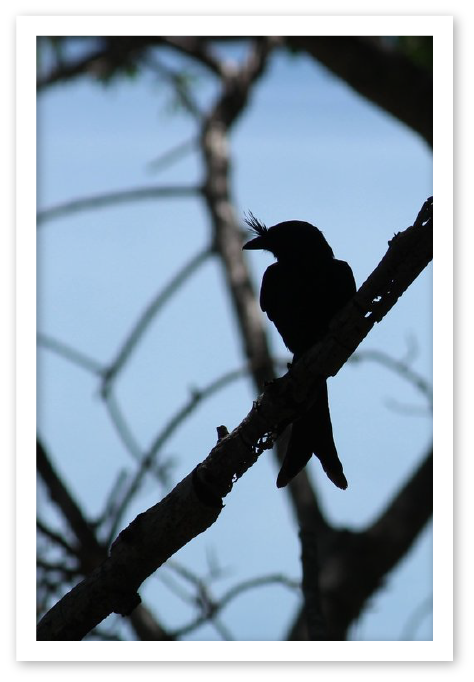
There was a great fire, raging through Madagascar and many animals were doing whatever they could to try and fight the fire. One animal in particular was pulling more than their own weight. The fruit bats were having a great impact upon the fire, by far the most of any animal. However, the drongo saw an opportunity. They swooped down and covered themselves in the ashes of the fire, turning their feathers black, and flew to see God. They claimed the work of the fruit bats as their own, and God in turn rewarded them, giving them the title of either ‘king of the birds’ or ‘king of all creatures’ depending on which part of Madagascar you are from. The fruit bats flew to God, and explained that they had been the ones to put out the fire, that it had been they that had done all the work. But God did not believe them. And thus the drongo, cheeky and mischievous as it is, became the ‘king of birds’ in Madagascar.
While the drongo is one of the more common species on Madagascar, the ‘king of the birds’ is also definitely one of the most interesting. Its amazing ability to mimic the cries of other birds, and remarkably opportunistic hunting repertoire, has allowed the crested drongo to thrive. Despite just how common it is; it was a species worthy of much greater appreciation than what I gave it during my time in Madagascar. Looking at it now, I can see that it is one hell of a little bird!
Check out our Forest Conservation Program on Nosy Komba!
Follow Angus’s Blog Here
References
1. Gardner, C. J. & Jasper, L. D. 2014. A record of vertebrate carnivory by the Crested Drongo (Dicrurus forficatus). Malagasy Nature, 8: 105-106.
2. Deception by Flexible Alarm Mimicry in an African Bird, Tom P. Flower et al, Science May 1 2014
3. IUCN Red List, ‘Madagascar Crested Drongo’ https://www.iucnredlist.org/details/22706952/0
AboutMadagascar Volunteer
Madagascar Volunteer is the team behind this website. Our writers and reviewers have all worked on the ground here, on our own programmes and in the villages we support. We aim to give you clear, current facts, so you know what a placement involves and can plan your trip with care. Every article is checked before it goes live. We believe in volunteering the right way: good for the people we work with, good for the wildlife, and good for you.