

BlogForest Conservation
During my time at the Madagascar Research and Conservation Institute, going out and searching for reptiles and amphibians was one of the most enjoyable parts of the job. Day or night, I was (almost) always keen to get out and conduct another reptile survey. Night surveys were particularly interesting. We tended to conduct these only once a week, rather than the at times every day of the daytime hikes, which meant that these were a special (but tiring) treat. Night walks gave us a fantastic opportunity to get out and spot some of the more mysterious species of Nosy Komba. The daylight walks were great but there were many species that we’d never get the opportunity to see on these walks. It was only once night fell that we’d get the best opportunity to find some of these bizarre creatures—especially the leaf-tailed geckos of Nosy Komba.
These experiences also made me appreciate the importance of forest conservation. Every reptile and amphibian we encountered depended on intact, healthy forests for survival, and seeing them in their natural habitat reinforced how vital it is to protect these ecosystems. Preserving these forests isn’t just about the trees—it’s about safeguarding the entire web of life they support.
Nocturnal Gecko Encounters
At night, the day geckos (Phelsuma) would largely disappear (funnily enough), and in their place would emerge a variety of new nocturnal geckos, each one perhaps more bizarre than the last. This was highlighted by a particularly cool gecko that could shed all of its scales when grasped by a predator, leaving just a pink, slimy little body and a predator with a mess of slime and scales! What the hell?!
A couple of the nocturnal geckos are absolute masters of camouflage and are unlike anything I’ve ever seen
The Camouflage Masters: Uroplatus
The leaf-tailed geckos of Nosy Komba, belonging to the genus Uroplatus, are extraordinary. There are two branches of gecko within the genus, categorized by their camouflage: the larger, mossy or bark-like leaf-tailed geckos (like U. henkeli or U. sikorae) and their smaller siblings, the leaf-like leaf-tailed geckos. Across the board, these are some pretty cool geckos, but the larger leaf-tailed geckos are out of this world!
The Uroplatus henkeli is found on Nosy Komba, and their camouflage makes them ridiculously difficult to spot. Almost every volunteer that came through our camp dreamed of being able to see one of these elusive reptiles! However, these geckos have only ever been found on one of our transects. To make it even more difficult for the volunteers to see one, we only get to do nocturnal surveys at the site in question as part of a semi-regular overnight hike. So to say that they were a rare find was an understatement!
Uroplatus henkeli: Henkel’s Leaf-Tailed Gecko
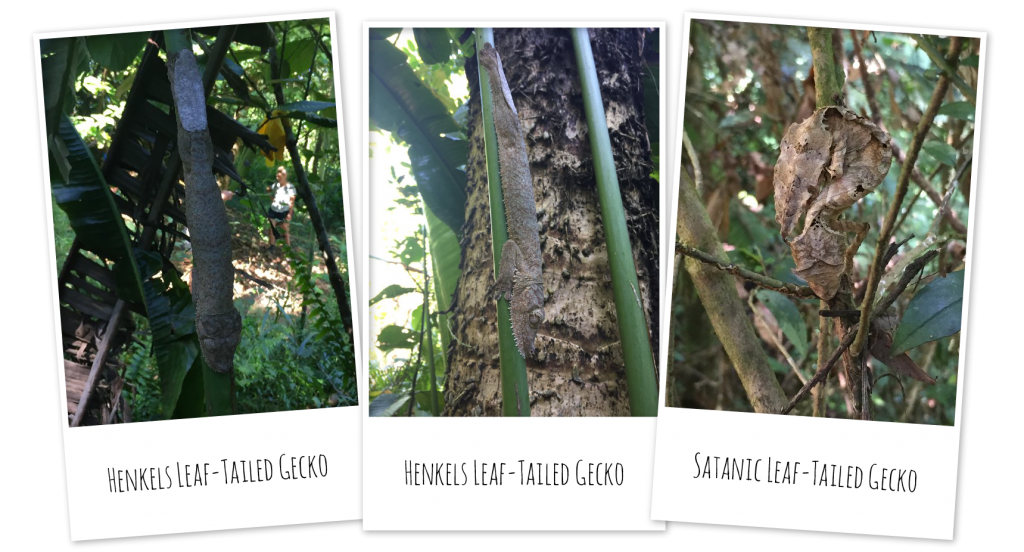
Henkel’s leaf-tailed gecko (Uroplatus henkeli) is a simply awesome specimen of a lizard! They are a fairly large species, recorded to grow up to nearly 30cm long. This makes it one of the largest of the leaf-tailed geckos and one of the largest geckos in the world. They have mottled brown colouration, with a large, flat head and tail.
But what is it exactly that makes this (so far) relatively plain-sounding lizard such a camouflage aficionado?
Well, on top of their mottled colouring which matches the trees that they rest on, their bodies have developed a little adaptation which helps mask them even further. The Henkel has grown little tubercles along the sides of its body, specifically along the underside of the jaw, and its body up to the back legs. This fringing breaks up the outline of the gecko, making it near indistinguishable from the bark of the tree. It sounds crazy and hard to believe, but having seen it first-hand, when they lie flat against the tree trunk they are nigh impossible to make out unless you happen to be looking at the tree from a particular angle.
During a walk through Lokobe National Park, I had a henkeli pointed out to me but was simply unable to see it until I changed the angle that I was looking at the tree in question. This experience made me fully appreciate just how good the camouflage capabilities of the mossy leaf-tailed geckos actually is.
There was another thing that made this species such a fixation for volunteers though. When describing this gecko to volunteers, we always made sure that this particular behavioural adaptation was highlighted because it was just SO strange. When threatened, the henkeli would raise its head and tail, open its large mouth wide, and let loose a shrill, piercing scream! To further add to it, over the years a fady (or taboo) developed in relation to the scream of the henkeli. Should a henkeli scream at you, it brings bad luck NOT to scream back at the gecko! Funnily enough, lots of volunteers kind of loved the idea of being ‘forced’ to scream at a gecko.
The Spearpoint Leaf-Tailed Gecko
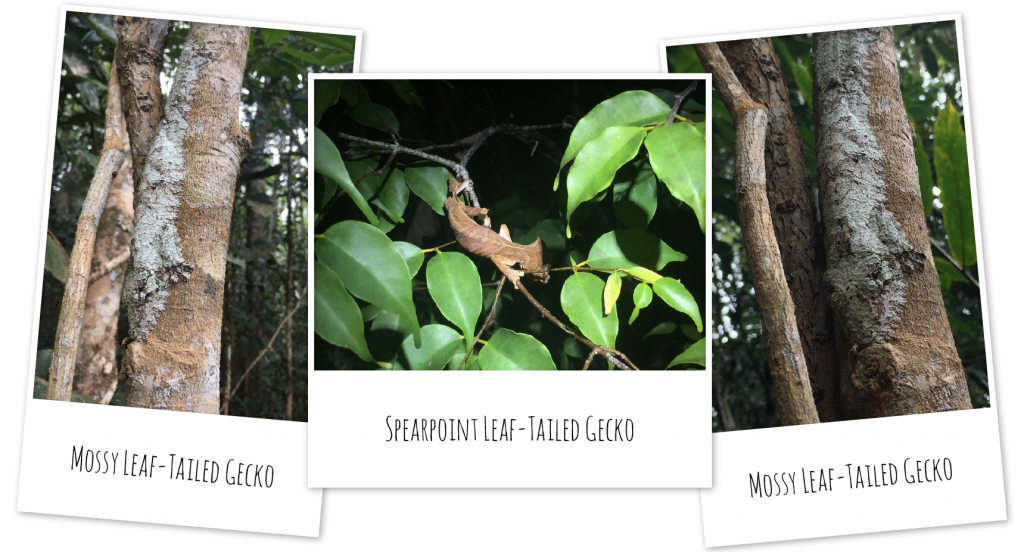
The ‘mossy’ henkeli is not the only species of leaf-tailed gecko on Nosy Komba though! The island is also lucky enough to be home to one of the smallest of the Uroplatus, the Spearpoint leaf-tailed gecko (Uroplatus ebenaui). These little guys are perhaps my favourite lizard on Komba! On top of being a cute little gecko, their heads look just a tad dragon-ish with little horns above their eye sockets. What’s not to like!
Despite lacking the mossy camouflage of its larger brethren, they still have developed some pretty sneaky little adaptations that allow them to blend into their arboreal homes. They have small bodies, and a lot of little ridges of skin running along their bodies. These skin folds have a neat little effect. In a similar sense to the henkeli, unless seen at the right angle, these ridges gave the ebenaui a distinctly leaf-like appearance as they sit themselves across a twig waiting for insects to fly, or crawl, past.
They also have a significantly shorter tail than other Uroplatus species, shaped like (funnily enough) the tip of a spear. When compared to other species in the leaf-like ebenaui-phantasticus complex, such as the Satanic leaf-tailed gecko of Ranomafana National Park, or the larger leaf-tailed geckos such as the henkeli or U. sikorae, the Spearpoint’s tail is significantly shorter. This likely suits their preference for thinner branches, where a smaller tail might help them remain less visible.
Encounters on the Mainland
I was lucky enough during my time travelling across mainland Madagascar to come across two other species of Uroplatus. My experience with these enigmatic geckos only further cemented them as my favourite lizards in Madagascar.
While exploring Ranomafana National Park, nearly a seven-hour drive south from the capital Antananarivo (Tana), our guide showed us a small tree and excitedly told us that somewhere on this plant was a leaf-tailed gecko. After a quick search, practically right in the middle of this little tree, was a gecko; Uroplatus phantasticus, or the Satanic leaf-tailed gecko. Getting the name from its devilish ‘horns’ above their eyes, this species has a larger tail than the Spearpoint, and looks almost exactly like a dead leaf! Males even have notches on their tails, helping complete the illusion.
In Andasibe National Park, we found Uroplatus sikorae, one of the smaller species of the bark-like geckos. Again, I was blown away by how much the sikorae looked like a patch of moss or lichen on a tree. The camouflage was absolutely incredible.
Conservation and Discovery
Currently, 14 species of Uroplatus are recognized, ranging from the Giant Leaf-Tailed Gecko (Uroplatus fimbriatus) which grows over a foot long, to the ten centimeter long ebenaui. Almost all of these species—like the leaf-tailed geckos of Nosy Komba—are listed as at least ‘vulnerable’ by the IUCN. Only the Satanic leaf-tailed gecko is listed as ‘least concern.’
Because of their incredible camouflage, these geckos are in high demand in the exotic pet trade. All Uroplatus species are listed on CITES Appendix II, and in 2004 the WWF included them on its “10 Most Wanted Species” list to raise awareness about the dangers of illegal wildlife trade.
Even within protected areas like national parks, these geckos are still being captured and sold. This makes it incredibly difficult to ensure their long-term conservation.
There is also still a lot we don’t know. Scientists are fairly confident that there are more than 14 species—especially within the U. ebenaui complex. When new species are confirmed, most are likely to be listed as endangered too, given the status of those already described.
Habitat Loss Threatens Camouflaged Survival
These incredible leaf-tailed geckos of Nosy Komba and elsewhere are also at risk due to habitat destruction. They depend on intact, healthy forests to survive. Without trees, their camouflage becomes useless. Many species only live in small, fragmented forest patches. As Madagascar’s forests shrink, so too does the future of these remarkable reptiles.
Author: Angus Hamilton
Check out our Forest Conservation Program on Nosy Komba!
Follow Angus’s Blog Here
REFERENCES
Arkive (2017). Satanic leaf-tailed gecko videos, photos and facts – Uroplatus phantasticus | Arkive. [online] Arkive. Available at: http://www.arkive.org/satanic-leaf-tailed-gecko/uroplatus-phantasticus/
CITES (2017). How CITES works | CITES. [online] Cites.org. Available at: https://www.cites.org/eng/disc/how.php
IUCN (2017). Uroplatus ebenaui. [online] Iucnredlist.org. Available at: http://www.iucnredlist.org/details/172792/0
IUCN (2017). Uroplatus henkeli. [online] Iucnredlist.org. Available at: http://www.iucnredlist.org/details/178653/0
IUCN (2017). Uroplatus phantasticus. [online] Iucnredlist.org. Available at: http://www.iucnredlist.org/details/172906/0
World Wildlife Fund (2017). WWF Announces ’10 Most Wanted Species’ | Press Releases | WWF. [online] World Wildlife Fund. Available at: https://www.worldwildlife.org/press-releases/wwf-announces-10-most-wanted-species